The global railway industry faces a constant battle against track degradation and escalating maintenance budgets. Traditional ballast tracks, while versatile and cost-effective to install, often suffer from uneven load distribution and rapid ballast attrition under heavy traffic and high-speed operations. At SFFST, a leading professional manufacturer of rail fastening systems and components, we are at the forefront of solving these challenges with innovative elastic solutions. By integrating the Under sleeper Pad system into modern infrastructure, we provide a transformative approach to enhancing track performance. This blog explores how SFFST technology outperforms traditional ballast structures, significantly improving track stability while drastically reducing the railway’s total cost of ownership.
The Mechanics of Traditional Ballast Track
Challenges in Ballast Track Maintenance
In a conventional setup, the contact area between the concrete sleeper and the ballast is limited to the “peaks” of the stones. This creates extreme “point loading,” where the entire weight of a train is concentrated on tiny surfaces. Over time, these pressure points cause the ballast to crush, a process known as ballast degradation. As the stones lose their angularity and turn into fines, the track loses its drainage capability and structural geometry, leading to frequent and costly ballast track maintenance.
Limitations of Conventional Sleeper-to-Ballast Contact
Conventional tracks often require frequent tamping to restore the desired track geometry. However, tamping is a double-edged sword; while it realigns the track, the mechanical tines of the tamping machine further break down the ballast stones. This creates a cycle of diminishing returns where the intervals between maintenance sessions become shorter and shorter, significantly driving up the railway lifecycle cost.
Engineering Excellence: The SFFST Under Sleeper Pad
Core Functions of the Under Sleeper Pad System
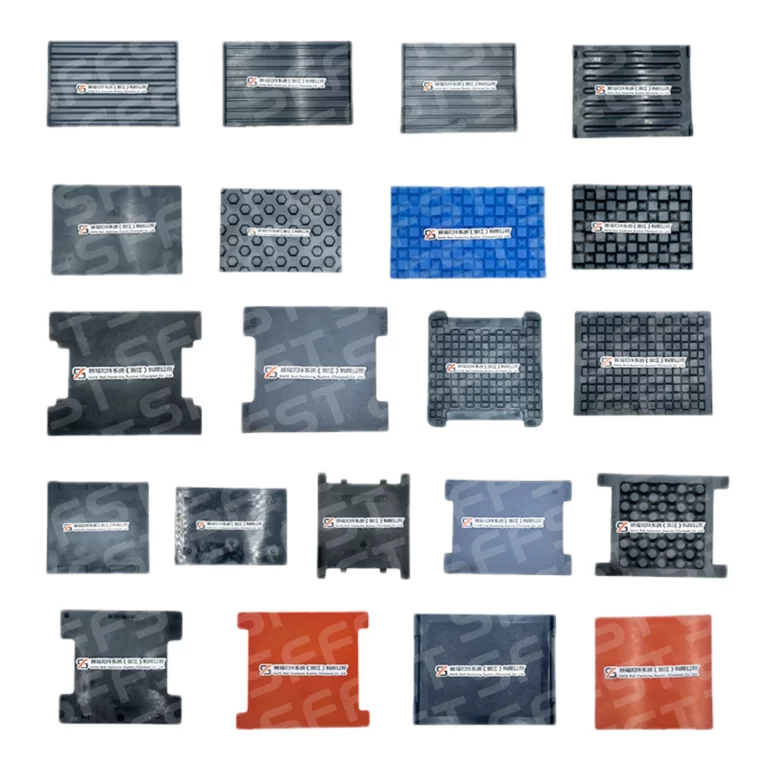
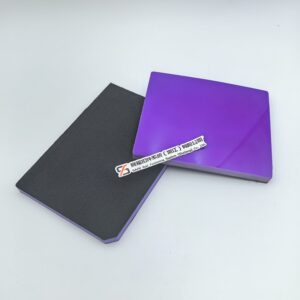
The Under sleeper Pad serves as an elastic “cushion” between the sleeper and the ballast. Its primary roles include vibration damping, even load distribution, and track protection. By increasing the effective contact area between the sleeper and ballast, the Under Sleeper Pad helps distribute loads more evenly and reduce localized stress concentrations.
Advanced Material Selection: Polyurethane and Composites
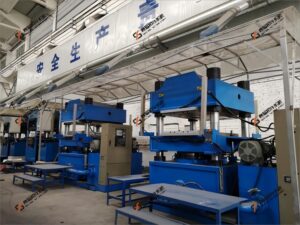
We utilize high-quality Polyurethane and specialized composite materials to ensure our pads maintain their elasticity over decades of service. Our Automatic Polyurethane Pouring Machine Production lines utilize digital CNC technology to ensure precision in every pad, whether it is for a resilient tie pad/elastic pad or a full-scale Under sleeper Pad. These materials are tested in our Non-metal Lab using an Electro-hydraulic servo fatigue testing machine to ensure they can withstand millions of load cycles without losing their damping properties.
SFFST Precision Manufacturing and Quality Standards
At SFFST, quality is not just a goal; it is a manufacturing standard. Our production lines are equipped with over 100 sets of advanced automation equipment. Every Under Sleeper Pad we produce undergoes rigorous validation to meet international standards such as EN 13146 and EN 13481, as well as domestic TB standards. This ensures that when you choose an SFFST product, you are choosing a component backed by 40+ years of manufacturing expertise.
Performance Comparison: Stability and Stress Distribution
Uniform Load Distribution for Enhanced Track Stability
The introduction of our Under sleeper Pad creates a “bedding” effect. This allows the ballast stones to partially embed into the pad, creating a much larger and more uniform support surface. This uniformity is crucial for track stability improvement, as it prevents the lateral and vertical migration of ballast stones, which is the primary cause of track misalignment.
Reducing Settlement Speed and Structural Deformation
Track settlement is a major concern for high-speed lines using systems like the WJ-7 Fastening System or WJ-8 Fastening System. Our research and on-site project data, such as from the Morocco Kenitra-Marrakech High-Speed Railway Project, show that tracks with USP exhibit a much slower and more predictable settlement rate. By absorbing dynamic energy, the Under sleeper Pad prevents the subgrade from being overstressed, thereby maintaining the structural integrity of the entire railway embankment.
Impact on Noise Reduction and Vibration Damping
Beyond structural stability, our Under sleeper Pad system is an essential tool for noise reduction. In urban metro projects, such as the Chengdu Metro Line 17 Project, we have successfully implemented vibration and noise mitigation systems that utilize elastic layers to absorb the high-frequency energy that traditional ballast tracks would otherwise radiate as noise.
Maintenance Optimization and Operational Efficiency
Reducing Tamping Frequency in Ballast Track Maintenance
One of the most measurable under sleeper pad advantages is the reduction in tamping frequency. Studies and industry experience have shown that Under Sleeper Pads may significantly extend tamping intervals depending on traffic conditions, axle loads, and ballast quality. This not only reduces the direct labor and machinery costs of ballast track maintenance but also prevents the secondary damage to the ballast caused by the tamping process itself.
Extending the Service Life of Ballast and Sleepers
By protecting the ballast from crushing and the sleeper from impact damage, the SFFST Under sleeper Pad extends the functional life of these expensive assets. This is particularly critical in heavy-haul environments where we supply products like the S30HH Fastening System or W14HH Fastening System, where axle loads are extreme and component wear is accelerated.
Case for Under Sleeper Pad Advantages in Heavy-Haul Rail
In projects like the Fenghong and Jingshen Railway projects, where we supplied 130,000 sets of high-performance fastening systems, the durability of the track bed was paramount. The use of elastic components ensures that the Rail Clip/Tension Clamp, such as our SKL Tension Clamp, operates within its designed fatigue limits by reducing the overall “harshness” of the track structure.

Engineering Economics: Railway Lifecycle Cost Analysis
Quantifying Railway Maintenance Cost Reduction Strategies
By adopting our EPC+M+O entire solution, railway operators can precisely quantify their savings. We don’t just sell a product; we provide a full-lifecycle management service that optimizes every stage of the project to ensure the lowest possible railway maintenance cost reduction.
The ROI of Implementing an Under Sleeper Pad System
Ultimately, the ROI is found in the railway’s total cost of ownership. A track that stays in geometry longer, requires less ballast cleaning, and protects its Rail Fastening System components will always be more profitable than a traditional “rigid” ballast track. As a partner in your infrastructure’s success, SFFST ensures that every dollar spent on elasticity yields multiple dollars in saved maintenance and extended asset life.
Conclusion
The transition from traditional ballast tracks to systems enhanced with Under sleeper Pad technology represents a significant leap in railway engineering. As demonstrated, SFFST provides high-performance solutions that address the root causes of track instability and ballast wear. By optimizing the interaction between the sleeper and the ballast, our pads ensure a more resilient, quieter, and more durable infrastructure. Whether for high-speed rail, heavy-haul lines, or urban transit, adopting SFFST technology is not just an engineering upgrade—it is a strategic financial decision that minimizes railway lifecycle cost and secures the future of efficient rail transport.
Contact SFFST today to discover how our innovative Under sleeper Pad solutions and EPC+M+O services can optimize your railway maintenance cost reduction and enhance long-term track performance.
FAQ
Q: What are the primary benefits of under sleeper pads in railway systems?
A: The primary benefits of under sleeper pads include superior vibration damping, even load distribution, and the protection of both ballast and sleepers. They effectively reduce the stress concentrations that lead to component failure, thereby extending the overall track lifespan and reducing railway maintenance costs.
Q: Can under sleeper pads reduce the railway’s total cost of ownership?
A: Yes. Through a comprehensive railway lifecycle cost analysis, it is evident that the drastic reduction in ballast track maintenance and tamping frequency leads to significant long-term savings. This ensures a much lower railway total cost of ownership over the typical 30- to 60-year lifespan of a railway line.
Q: What materials does SFFST use for its under sleeper pad system?
A: SFFST utilizes high-quality polyurethane and specialized composite materials. These are manufactured using our Automatic Polyurethane Pouring Machine Production lines to ensure consistent elasticity and durability across various environmental conditions, from high-speed rails to heavy-haul lines.