As global railway networks undergo rapid modernization, the interface between road and rail—the level crossing—has become a critical focal point for safety, noise control, and structural integrity. For decades, reinforced concrete was the go-to material for these transitions, but the increasing speeds of passenger trains and the heavy axle loads have highlighted its performance limitations. At SFFST, we have dedicated over 40 years to perfecting the art of rail fastening and infrastructure components. Today, our Railway Rubber Level Crossing (also known as the Rubber Crossing Plate) is at the forefront of this technological shift. By integrating advanced material science with modular engineering, we provide a Railway Crossing Solution that offers significant performance advantages over many traditional concrete crossing systems. In this blog, we will explore why modern rail projects are moving away from concrete and how SFFST is leading the way with “Fastening Excellence, Entire Solution”.
Limitations of Traditional Concrete Railway Crossings
Structural Failure Under High Dynamic Wheel Loads
Traditional concrete crossings often struggle with the extreme vibrations generated by modern high-speed and heavy-haul trains. Over time, the rigid nature of concrete leads to micro-cracks, which eventually expand into deep cracks. This is particularly problematic in “Heavy-haul railway” environments where constant pressure causes the concrete to crumble. Once the structural integrity is compromised, the crossing becomes a hazard for both road vehicles and rail traffic.
The Problem of Mud Pumping
One of the most persistent issues with concrete crossings is mud pumping. Because concrete does not provide an effective sealing performance with the rail, water can seep into the track substructure. As trains pass over, the resulting pressure forces a slurry of mud and water upward through the gaps, fouling the ballast and reducing track support stiffness. This phenomenon significantly increases the frequency of Railway Crossing Maintenance and can lead to dangerous track geometry defects.
Understanding SFFST Railway Rubber Level Crossing
Advanced Material Formula and Modular Design
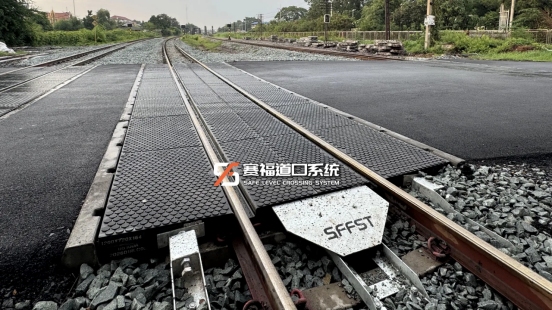
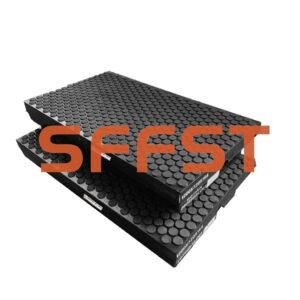
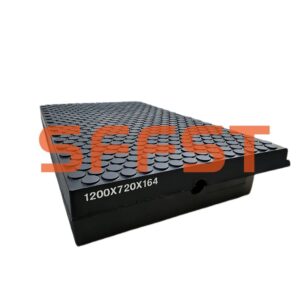
At SFFST, our Railway Rubber Level Crossing is manufactured using an advanced rubber compound developed through continuous material optimization and automated production processes. This specialized composition ensures that our grade crossing panels are engineered for high strength, excellent resilience, and long-term durability. Unlike concrete, which is cast in large, monolithic concrete slabs, our rubber crossings feature a modular design. We typically provide these in standard sets of 1.1 linear meters, but we have also developed models of 1.65 linear meters and 2.2 linear meters to suit diverse project scales.
Compatibility With Diverse Rail and Sleeper Types
Versatility is a core pillar of our manufacturing philosophy. We recognize that different regions and rail types require specific configurations. Our Railway Rubber Level Crossing is meticulously designed to adapt to various rail weights, including P43Kg, P50Kg, and P60Kg. Furthermore, our system is compatible with both wooden sleepers and concrete sleepers, ensuring a seamless fit regardless of the existing Railway Infrastructure.
Key Benefits of SFFST Rubber Level Crossing
Remarkable Durability and Extended Service Life
Through extensive laboratory testing at our Laboratory, we have enhanced the service life of our Railway Rubber Level Crossing from 150,000 cycles to an impressive 450,000 cycles. In practical usage scenarios, this extended lifespan translates to a durability of 10 to 15 years, more than adequate to meet the rigorous demands and requirements associated with the increasing speeds of modern railways.
Superior Vibration Damping and Noise Reduction
Our rubber panels act as a high-performance vibration damping layer. The high-elasticity rubber compound effectively mitigates the impact of road traffic and rail wheels, providing excellent vibration damping and noise reduction. This makes our Railway Level Crossing Solutions ideal for urban environments where noise pollution is a significant concern for local residents.
Rubber vs. Concrete: A Detailed Comparison
Maintenance Cycles and Long-Term Economy
While the initial procurement cost of a Modular Railway Crossing might be higher than concrete, the total lifecycle cost is significantly lower. Concrete crossings require frequent repairs due to cracking and ballast fouling. In contrast, our Railway Rubber Level Crossing is wear-resistant and aging-resistant, with minimal deformation after repeated compression. By reducing the frequency of crossing maintenance, we help rail operators achieve substantial economic benefits over time.
Installation Efficiency and Operational Stability
Our rubber panels are designed for rapid installation and easy cleaning. Unlike concrete, which requires curing time and heavy machinery for placement, our modular panels can be manually or mechanically installed with precision. This minimizes track possession time and ensures that the Railway Crossing System can return to operational status quickly.
Applications Across Modern Rail Networks
High-Speed and Conventional Rail Projects
Our products have been proven in some of the most demanding projects globally. For instance, in 2022, we supplied our high-performance Railway Rubber Level Crossing for the Wuhan-Huangshi Intercity Railway Project. Whether it is for China’s vast high-speed rail network or international projects like the Morocco Kenitra-Marrakech High-Speed Railway, our components ensure stability at high velocities.
Industrial, Mining, and Urban Transit Systems
Beyond mainlines, SFFST solutions are widely used in specialized environments. Our crossings are perfectly suited for freight yards, station luggage car aisles, and inspection workshops inside vehicle depots. For “Heavy-haul Rail” such as those found in mining and industrial dedicated lines, our Heavy Duty Rubber Level Crossing Panels provide the necessary bearing capacity to handle immense axle loads.
Buying Guide for Your Rail Project
Essential Factors for Selecting Crossing Panels
When selecting a Railway Level Crossing Solution, you must consider the specific parameters of your track. At SFFST, we recommend evaluating:
- Rail Type: Ensure compatibility with P43Kg, P50Kg, or P60Kg rails.
- Sleeper Type: Specify whether the panels will be laid on wooden or concrete sleepers.
- Traffic Load: Determine if the crossing needs to handle urban light rail or heavy industrial freight.
Importance of Precision Engineering and Testing
We operate specialized Non-metal Labs where we conduct vital tests including Static Stiffness, Dynamic Stiffness, and Fatigue Performance. Our Drop Hammer Impact Test System and MTS Servo-Hydraulic Testing System (25T) ensure that every panel leaving our 50,000 ㎡ factory meets international standards like ISO 9001 and CRCC.
SFFST Customization and OEM Solutions
Tailoring Specifications to Unique Project Needs
Through our OEM/ODM Rail Solutions, we provide customized rubber and plastic product services. We can adjust material ratios and dimensions to meet specific functional requirements, such as enhanced oil resistance for industrial sites or specific color requirements.
Comprehensive EPC+M+O Support Services
SFFST is more than just a manufacturer; we are a one-stop partner for reliable rail solutions. Our EPC+M+O framework covers everything from Engineering (Fastening system design) to Operation (24/7 localized technical support). We even provide on-site worker system training to ensure your Railway Crossing Panel Installation is executed perfectly.
Conclusion
The transition to Railway Rubber Level Crossing systems is a logical step for any rail network prioritizing longevity, safety, and passenger comfort. By choosing SFFST, you are partnering with a manufacturer that combines four decades of experience with cutting-edge automation and a commitment to environmental responsibility. Our solutions don’t just bridge the gap between road and rail; they enhance the entire efficiency of the Railway Infrastructure.
Contact SFFST today to discuss your project requirements and discover how our high-performance Railway Rubber Level Crossing can optimize your infrastructure!
FAQ
Q: Is the installation of rubber crossing panels difficult?
A: Not at all. Our Railway Rubber Level Crossing features a modular design with standard set lengths like 1.1m, 1.65m, and 2.2m. They are designed for easy cleaning and secure attachment to railway spikes and sleepers, allowing for much faster installation and maintenance than cast-in-place concrete.
Q: Can these crossings handle heavy industrial or mining traffic?
A: Yes. SFFST rubber crossings are specifically designed for high-strength, compression-resistant, and wear-resistant applications. They are suitable for dedicated lines for enterprises, mines, and freight yards where heavy-duty performance is required.
Q: Does SFFST provide customization for specific rail weights?
A: Absolutely. We can customize our Railway Rubber Level Crossing to fit various rail types, including P43Kg, P50Kg, and P60Kg, and can provide tailored material ratios to meet unique project specifications through our OEM/ODM Rail Solutions.